The OpenAPI toolchain
that lives on the edge.
Filter, merge and convert the OpenAPI documents your backends generate, and serve each result at a URL that stays current with your APIs. Your docs, your SDKs and your partners each get the part they need, without a line of code in your backends.
Open source. Free to start here, or deploy it to your own Cloudflare account. View on GitHub
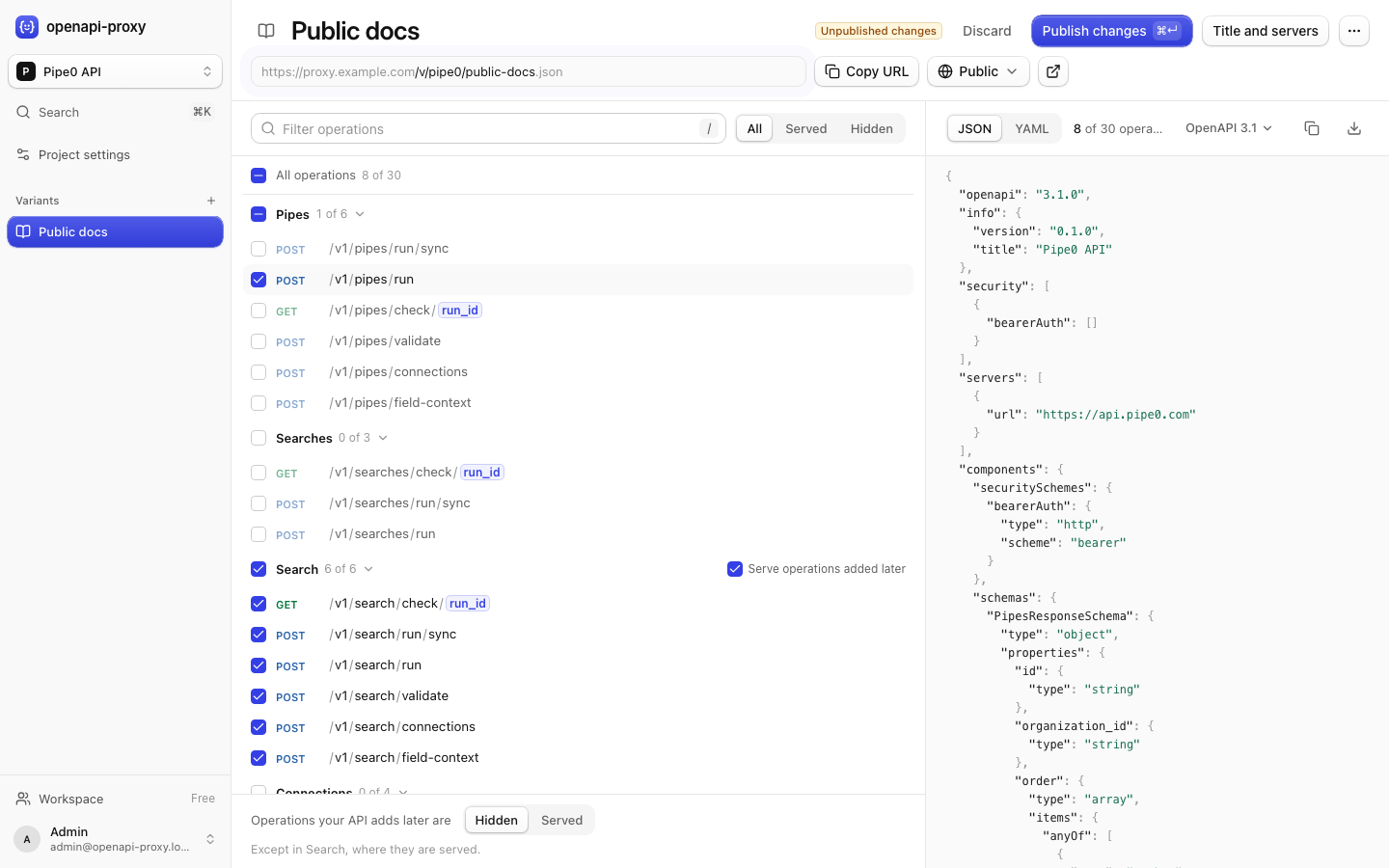
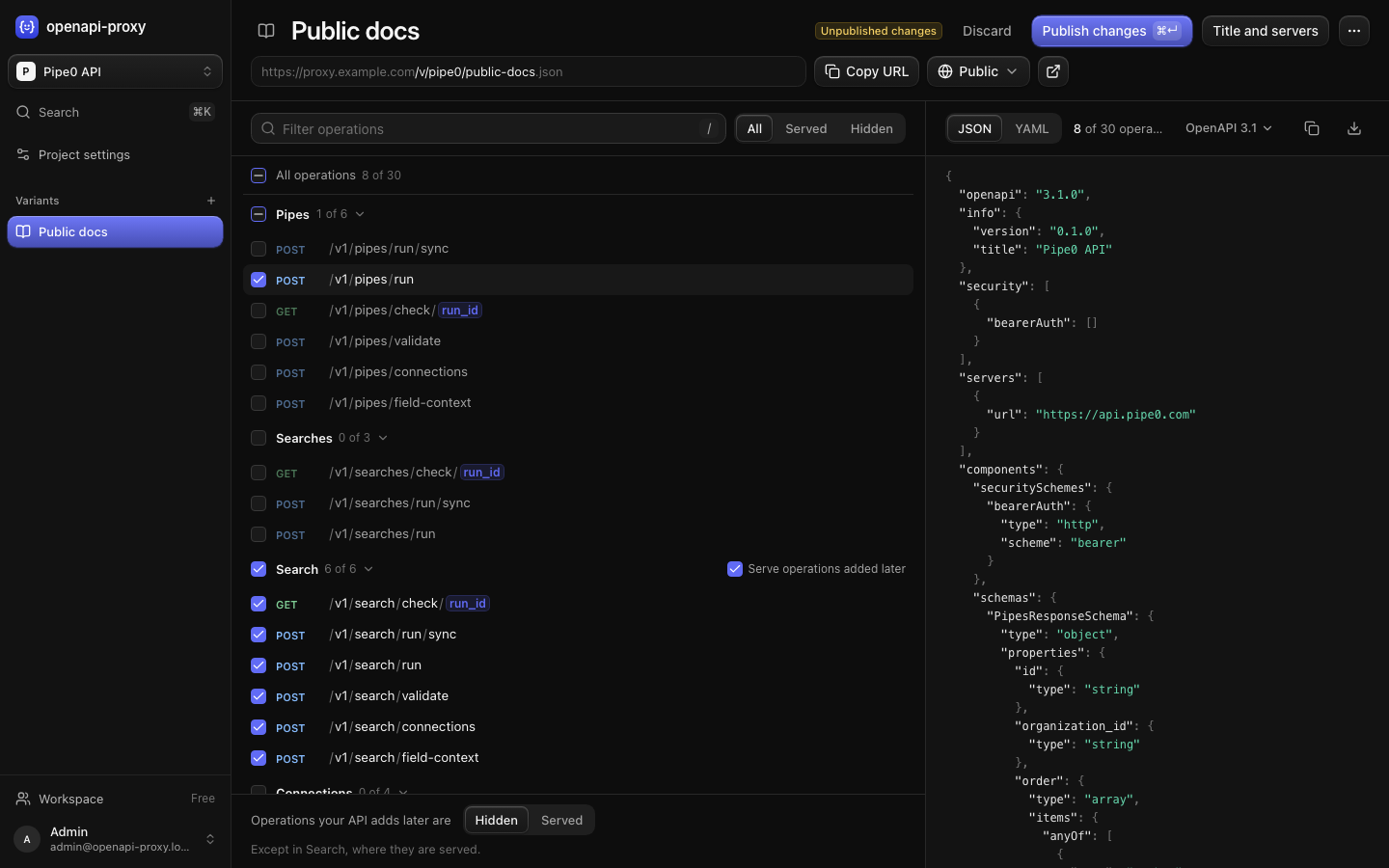
One OpenAPI document. Many consumers.
Docs, SDKs, partners, tests and agents each need a different subset of your operations. Each subset becomes a variant, served at its own URL and current with the source.
- Core API
- Billing
- Search
175 operations
- Public docs33
- Public SDK31
- Partner API12
- Contract tests58
- Agent tools18
- Internal docs175
Ship the endpoint now. Publish it when it is ready.
A new operation stays out of a variant until you include it. Publishing it is a click, not a pull request and a deploy.
- GET/v1/charges
- POST/v1/charges
- GET/v1/customers/customer_id
- POST/v1/refunds
- GET/v1/charges
- POST/v1/charges
- GET/v1/customers/customer_id
- POST/v1/refunds
What people use it for
Public docs without internal endpoints
Check the tags and operations that are public. The variant serves those and exactly the schemas they reference, so no internal model is left behind in components.
Read the postA document for each SDK and partner
Every selection gets its own URL, as JSON and YAML. Your docs read one, your SDK generator another, a partner a third. Changing who sees what takes a click, not a deploy.
Read the postSeveral services, one document
Merge the documents of up to ten services into one. Two schemas that share a name but not a meaning are told apart, and you are shown what the merge did.
Read the postOpenAPI 3.0 for the tools that need it
Serve a variant as 3.0 or 3.1, whatever your framework generates. Where 3.0 cannot say something, you are told exactly what was left out.
Read the postHear when your API changes
Each check compares operations, not text. You get an email that says what was added, changed or removed, and which variants it touches.
Read the postCurrent when it is read
A copy older than the check interval is never handed out on trust, and a failing API never turns into an error for your readers. No pipeline step, nothing to regenerate.
Read the docsFor scripts and agents too
Everything the app does is an HTTP API, and an MCP endpoint offers the same as tools. Ask an agent for a variant with only the billing endpoints and get the URL back.
Read the docsPrivate sources stay private
A document behind authentication is fetched with headers you provide, stored encrypted and only ever sent to that document's own origin.
A workspace for the team
Invite your colleagues. Everyone works on the same projects and variants, so the public docs do not depend on one person being around.
A filter written by hand keeps more than it shows.
The usual shortcut is a loop in the backend that drops paths by tag. It rarely touches the schemas, so the public document still describes every internal request and response, for anyone who scrolls down.
{
  "paths": {
    "/v1/books": { … }
  },
  "components": {
    "schemas": {
      "Book": { … },
      "AdminAuditEntry": { … },
      "InternalBillingRun": { … },
      "StaffImpersonation": { … }
    }
  }
}
One public path is left. The schemas of the internal ones are all still there.
{
  "paths": {
    "/v1/books": { … }
  },
  "components": {
    "schemas": {
      "Book": { … }
    }
  }
}
What the kept operations reference comes along. Everything else is gone, including tags and security schemes nobody uses anymore.
Free to start.
Every feature is in both plans. Compare plans
Free$0
Enough for most teams: a few APIs, each with its audiences.
- 3 projects
- 15 variants
- 5 MB per project
Pro$69 per year
For companies with many APIs, or many audiences for them.
- 100 projects
- 100 variants per project
- 5 MB per project
On your own account
openapi-proxy is open source and runs on Cloudflare Workers. Deploy it to your own account and there is no plan to buy.